cTrader Integration with ProximoCRM
The Technological Foundation for a Modern STP/ECN Broker
cTrader Integration with ProximoCRM. The electronic trading market (Forex/CFD) has entered an era of total automation and hyper-competition. A decade ago, it was enough for a broker to provide clients with a terminal developed in the 2000s and a minimal set of marketing tools to hope for success. Today, that is catastrophically insufficient. The modern trader demands not just access to quotes, but absolute transparency, interbank-level execution speed, and personalized service, which is only possible through a deep understanding of their trading behavior.
In this arms race, the winners are those brokers who have managed to build a seamless technological ecosystem. The key elements of this ecosystem are two components: a cutting-edge trading platform and an intelligent CRM (Customer Relationship Management) system.
How the integration of the flagship cTrader platform from Spotware with ProximoCRM, the most powerful CRM for brokers, creates an unparalleled competitive advantage. We will explore not only the technical aspects of this combination but also the business benefits, issues of transparency, the STP/ECN model, and touch upon the topic of acquiring a turnkey cTrader White Label solution “powered by ProximoCRM.”
cTrader — The Evolution of Standards for STP/ECN Brokers. cTrader Integration with ProximoCRM.
Before discussing integration, it’s necessary to understand why cTrader occupies the niche of the best platform for STP/ECN brokers. To appreciate its revolutionary nature, it’s worth looking into the recent past.
The Gap Between Institutional and Retail Markets
Before the advent of cTrader, the market was strictly segmented. Institutional players (banks, hedge funds) used the ECN (Electronic Communication Network) model with direct access to liquidity. The minimum ticket size (lot) for operating in this system was around $1 million, making it inaccessible to retail.
Retail brokers were forced to operate under the Market Maker model or use RFQ (Request for Quotes). This created a fundamental conflict of interest: the broker was often engaged in manual hedging. The technology of the time did not allow for aggregating liquidity for small retail orders without losing speed and price quality
The Traders First Revolution
Spotware proposed the Traders First approach, which turned the industry upside down. They didn’t just improve existing models; they created a new infrastructure that made it possible to:
- Aggregate tickets, lowering the minimum entry threshold to $1000, and effectively down to micro-lots.
- Integrate leading Prime Brokers directly with retail brokers.
- Establish the FIX (Financial Information eXchange) protocol as the data transmission standard not only for institutions but also for retail.
As a result, retail brokers gained the same tools as the Wall Street giants. The trade execution transparency of cTrader became a new philosophy. The conflict of interest was eliminated: the broker now focuses more on extending the client’s lifecycle through quality service. cTrader Integration with ProximoCRM.
Technical Architecture: What’s Under the Hood?
The cTrader platform is known for its modern architecture. Unlike the outdated codebase of its competitors, cTrader was built from the ground up with modern requirements for speed, security, and user experience in mind.
- Execution Speed: The average order processing time is measured in milliseconds. This is achieved through a high-performance backend and low-latency protocols.
- Depth of Market (DOM): Full access to the “order book.” The trader sees the real liquidity available at different price levels, which was previously the sole prerogative of exchange traders.
- VWAP Execution: Orders are executed at the Volume-Weighted Average Price, guaranteeing fairness for trades of any size. The intelligent Smart Order Routing (SOR) system seeks the best available price among all connected liquidity providers and aggregates volumes.
- Cross-Platform Capability: A single codebase for the Web terminal, Desktop applications (Windows, Mac), and mobile devices (iOS, Android). This ensures a seamless experience when switching between devices.
ProximoCRM — The Intelligent Core of a Brokerage Business. cTrader Integration with ProximoCRM
If cTrader is the “engine” responsible for market interaction, then CRM is its “control system.” Generic CRMs are not suitable for the specific needs of Forex Brokers. A system is needed that understands entities like “trade,” “swap,” “commission,” “margin level,” and “risk management.”
ProximoCRM is a specialized solution created specifically for managing customer relationships in the financial sector. It acts as a central hub connecting marketing, sales, support, and financial accounting.
Core Modules of ProximoCRM
Lead Management and Partner Network
Automation of client acquisition through multi-tiered partner programs (IB — Introducing Broker). cTrader Integration with ProximoCRM. The system allows tracking the effectiveness of each partner in real-time and calculating complex commission structures.
Sales Funnel and KYC (Know Your Customer)
Automation of client verification, document upload, and regulatory compliance checks (AML). This is essential for any legal broker’s operation.
Financial Module
Management of deposits, withdrawals, and internal transfers. ProximoCRM integrates with most popular payment gateways and cryptocurrency processing systems, making financial operations transparent and fast.
Communications
Integrated telephony, HelpDesk, email tracking, integration with messengers, and ticketing systems for support.
Why a Generic CRM Isn’t Suitable?
Standard CRMs don’t understand financial specifics. They see a simple “deal” but cannot interpret what “partial execution of a limit order” means or why a trader received a margin call. ProximoCRM, thanks to its deep specialization, can operate with these concepts by receiving data from the trading platform. This is where the solution of deep cTrader integration with ProximoCRM comes into play.
Integration of cTrader with ProximoCRM as a Connecting Bridge
So, we have a powerful trading platform (cTrader) and an intelligent CRM (ProximoCRM). Separately, they are just tools. Connected together, they create a synergy that transforms a brokerage company into a high-tech organism capable of self-learning and optimization.
The integration of cTrader with ProximoCRM is not just a technical procedure of synchronizing logins and passwords. It is the creation of a bi-directional data channel that allows the CRM to understand the client’s trading behavior and the trading platform to take into account their personal settings and risks defined in the back office.
How It Works: A Technical Overview
Integration is typically implemented through several key mechanisms:
- API (Application Programming Interface): ProximoCRM uses cTrader’s open APIs to retrieve data and send commands. cTrader has well-documented REST and WebSocket APIs, allowing for real-time data acquisition.
- FIX Protocol: For critical information such as trade execution and balance changes, the direct FIX protocol is often used, guaranteeing minimal latency and reliable message delivery.
- Webhooks and Message Queues: When an action is performed in one system (e.g., an account deposit in the CRM), an event is generated and instantly transmitted to the other system (cTrader) to credit the funds to the trading account.
Client Data Unification (Single Source of Truth)
In a non-integrated broker, client data is scattered across different systems. The CRM stores their passport, email, and communication history. The trading platform holds their balance, open positions, and trading statistics.
Integration unites these worlds. When a client manager opens a user’s card in ProximoCRM, they see the complete picture:
- Personal data and interaction history.
- Current balance, equity, and margin level (live data from cTrader).
- Deposit/withdrawal history (from the CRM’s payment module).
- Detailed statistics on closed trades: win/loss ratio, instruments used, average trade duration, drawdowns.
This allows moving from templated communication to personalized consulting.
ProximoCRM for a Forex Broker — Data-Driven Management. cTrader Integration with ProximoCRM.
Integration transforms ProximoCRM into an analytical hub for managing client profitability (LTV — Lifetime Value). Let’s look at the key business processes made possible by the cTrader + ProximoCRM combination.
Client Segmentation Based on Trading Behavior. cTrader Integration with ProximoCRM
Thanks to the data flow from cTrader, the CRM can automatically assign tags to clients and distribute them into segments. For example:
- Scalpers: Clients with an average trade duration of less than 2 minutes and high order frequency. They can be offered accounts with minimal commissions and VPS for automated strategies.
- News Traders: Those whose trades concentrate around macroeconomic releases. They value the execution speed and market depth provided by cTrader.
- Long-term Investors: Hold positions for days or weeks. They can be offered capital management services and analytical reviews.
Marketing Automation (CRM-Marketing). cTrader Integration with ProximoCRM
Based on segmentation, ProximoCRM launches automated marketing campaigns.
- If the system sees a client hasn’t logged into the terminal for 2 weeks, although they usually trade actively, an automatic push notification or email is sent with a personalized offer (e.g., a commission discount for the next week).
- If a client makes a first deposit and executes their first trade, the manager receives a task to contact them, thank them, and offer help with platform setup.
Real-Time Risk Monitoring. cTrader Integration with ProximoCRM
For a broker operating under the STP model, integration allows setting up dashboards in ProximoCRM displaying clients approaching a critical margin level (Margin Level < 100%). Instead of waiting for automatic stop-outs in cTrader, the risk management department can proactively contact a large client and warn them about the need to add funds, thereby preserving loyalty and preventing deposit loss.
cTrader Trade Execution Transparency as a Marketing Asset. cTrader Integration with ProximoCRM
Transparency has become a quality standard for those looking to buy a turnkey cTrader White Label and successfully monetize it.
The Difference Between an Order and a Trade: A New Display Philosophy
The cTrader development team implemented a unique system for displaying trading operations, which has become the gold standard for transparency. The platform clearly distinguishes between an “order” (the trader’s request) and a “trade” (the report from the liquidity provider).
In the cTrader interface, the user can view a detailed “information timeline” for each position:
- Time the order was sent.
- Time confirmation was received from the LP (Liquidity Provider).
- Price at the time of sending.
- Actual execution price.
- Market Snapshot — a snapshot of quotes and liquidity at the moment of execution, explaining why slippage (positive or negative) occurred.
How This Helps the Broker Handle Objections
Clients often complain about slippage, suspecting broker manipulation. Integration allows these detailed reports to be saved in the client’s CRM card. When a trader contacts support, the operator can not just say “it was a market situation,” but can send them a PDF file with the market snapshot from cTrader, proving that liquidity at their stop-loss level was absent at that moment and execution occurred at the next best price. This builds trust at a level unattainable for “black box” platforms.
Depth of Market (DOM) as an Analysis Tool
The depth of market data broadcasted by cTrader can also be analyzed in conjunction with the CRM. If ProximoCRM sees a large cluster of liquidity for EURUSD shifting, it could be a signal for the analytical department to prepare an urgent market comment for clients trading that pair.
cTrader Integration with ProximoCRM. A Seamless Client Journey — From Registration to the First Trade
One of the main problems for Forex brokers is “dead souls”: clients register but never make a deposit. The integration of cTrader and ProximoCRM allows for maximizing onboarding automation and converting registrants into actual traders.
Automatic Trading Account Creation
The process looks like this:
- The client fills out a registration form on the broker’s landing page (the website is integrated with ProximoCRM).
- The data instantly enters the CRM, undergoing an initial check for duplicates and KYC compliance.
- The CRM, via the cTrader API, sends a command to create a new trading account (Real or Demo).
- The client receives an email with access details for cTrader Web/Mobile/Desktop.
- Important: All communication happens under a unified brand style. The client doesn’t see where the CRM ends and the trading platform begins — for them, it’s a single service.
Instant Deposits and Withdrawals
The ProximoCRM financial module, connected to payment systems, and the cTrader trading account are synchronized.
- When a client deposits funds through their personal cabinet (which is also part of the CRM ecosystem), the money goes through processing, and within seconds, the balance in the cTrader terminal updates.
- Upon a withdrawal request, the system automatically checks if the request exceeds available funds (based on data from cTrader) and, if open positions allow, initiates the transaction.
Trader’s Calculator and Risk Management
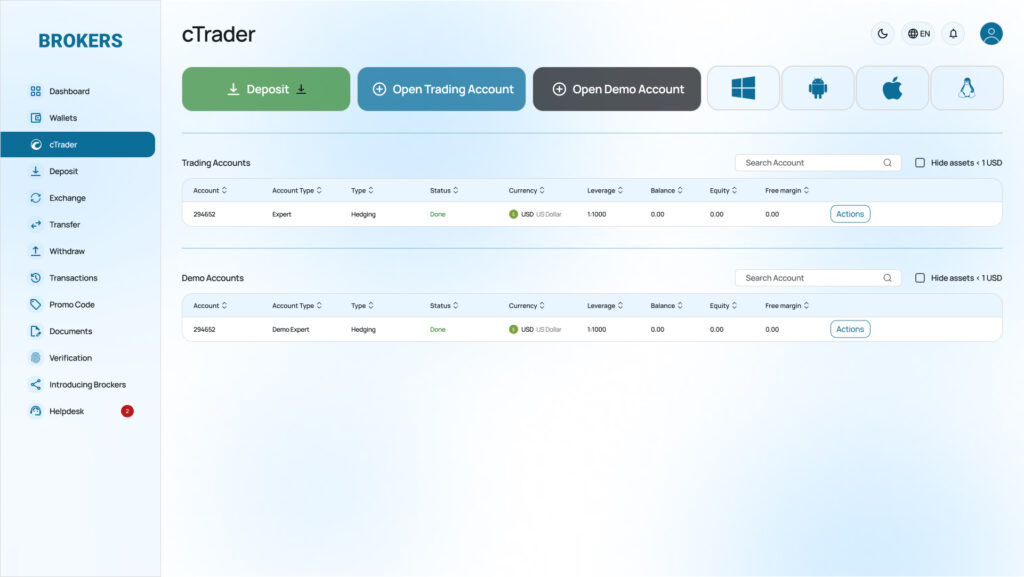
Integrated systems allow embedding a “Trader’s Calculator” into the client’s personal cabinet. Using current quotes from cTrader, it instantly calculates the pip value, margin required, and potential stop-out level for a desired trade volume.
cTrader Integration with ProximoCRM. White Label and Turnkey Infrastructure
Launching your own broker is a task requiring multi-million dollar investments in development and infrastructure licensing. The decision to buy a turnkey cTrader White Label becomes the optimal path for entering the market or expanding an existing business.
What’s Included in cTrader White Label?
The White Label (WL) solution from Spotware Systems includes a fully ready-to-use platform under the partner’s brand. But for full-fledged operation, the WL must be integrated with a back office. This is where ProximoCRM comes in.
“Turnkey” means the broker receives:
- Fully Branded cTrader Platform: Web, Desktop, Mobile applications with the company’s logo, corporate colors, and settings.
- Configured ProximoCRM: With an integrated sales funnel, partner program, and KYC.
- Payment Gateway: Connected deposit/withdrawal methods.
- Liquidity Bridge: Configured connection to a chosen liquidity provider or bank pool.
- Administrative Panel: A control center for managing risks, commissions, swaps, and trading instruments.
cTrader Integration with ProximoCRM. Advantages of Buying a Ready-Made Solution
- Speed to Market: Instead of 1-2 years of development, launch takes 2-4 weeks. The main time is spent on legal formalities and branding, not programming.
- Cost: Expenses are significantly lower than hiring an entire development team to build a platform from scratch. You pay for a license and support, not for millions of man-hours.
- Reliability: You get technology already tested by thousands of brokers and hundreds of thousands of traders worldwide. Bugs and vulnerabilities are fixed centrally by the Spotware team.
- Focus on Sales: You don’t need to think about hardware and software. You can concentrate on the main thing — attracting clients and developing the brand, using ProximoCRM tools.
Risk Management in the Age of Transparency. cTrader Integration with ProximoCRM
For a broker using the STP model (passing all trades to external markets), risk management doesn’t mean “how not to lose money on the client.” It means “how to manage liquidity flows and technical risks.”
Liquidity Management
A pure STP broker sends all client orders to their liquidity providers. However, if a broker has multiple LPs (Liquidity Providers), the task arises of choosing the best price and distributing the order flow. Data on execution quality (speed, number of rejections, liquidity depth) from each LP is analyzed and can be compared in the CRM against the overall profitability of the client base. This helps in making decisions about changing the primary liquidity pool.
Anomaly Monitoring
The integration, in conjunction, helps identify unusual behavior. For example, if multiple small accounts are opened from a single IP address, and they all start trading an identical strategy with abnormally high profitability, it could signal a latency trader or an attempted arbitrage. The CRM can block such accounts or switch them to manual trade confirmation mode for verification.
Automating Compliance Reporting
Regulators (FCA, CySEC, ASIC, etc.) require detailed reports on broker activity. An integrated system allows generating a report in a few clicks, containing:
- Client data and their verification status (from ProximoCRM).
- Complete transaction history (from the payment module).
- Detailed trading history, including execution prices, times, and counterparties (from cTrader).
Step-by-Step Plan for Launching a Broker on the cTrader + ProximoCRM Bundle
If you’ve decided to build your business on this technological foundation, here is a sample action plan.
Step 1: Legal Structure and License
Before buying a turnkey cTrader White Label, you need to decide on a jurisdiction. Will it be an offshore zone (Seychelles, BVI, St. Vincent) for maximum flexibility, or a regulated zone (Cyprus, UK) for access to the European market? The configuration of KYC/AML procedures in ProximoCRM depends on this.
Step 2: Choosing a Technology Provider
You find an integrator company that is a partner of both Spotware and ProximoCRM. You sign a contract for the supply of cTrader White Label and a ProximoCRM license. At this stage, it’s important to discuss technical details: number of servers, API access, support level (SLA).
Step 3: Branding and Configuration
Designers customize the platform’s appearance to match your brand. Technical specialists configure logos, icons, and domain names. Simultaneously, in ProximoCRM, sales funnels are set up, email templates are created, and trading conditions (spreads, commissions, swaps) are uploaded.
Step 4: Integration with Liquidity and Payments
The chosen liquidity pool is connected to cTrader. Payment providers are connected to ProximoCRM. A series of tests is conducted: account opening, deposit, trade execution, withdrawal. The speed and accuracy of data transfer between systems are verified.
Step 5: Launch and Optimization
After successful testing, the opening is announced. The first clients enter the system. It’s crucial at this stage to closely monitor the operation of automated scenarios in the CRM and adjust them based on real user behavior if necessary.
cTrader Integration with ProximoCRM. Use Cases of Integration in the Sales Department’s Work
Let’s move from the technical level to the practical level of use by the sales and support teams. How exactly does ProximoCRM for a Forex broker change the daily routine?
“Smart” Activity Feed
When a manager calls a client, they don’t just see a “1 lot trade” but the context. The cTrader widget inside the CRM shows:
- The current emotional state of the account (is the client in drawdown or profit?).
- The last action (just closed a losing trade and immediately opened a new one).
- Leverage usage (is the client risking too much?).
This allows the manager to start the conversation not with a templated “how are you?” but with an engaging: “I see you just closed a position on oil with a small loss. The market is indeed volatile today. Our analytics department has prepared a review of the current situation, would you like me to send it?”
Automating Post-Trading Service
After major news releases, when volatility spikes, the support department is usually flooded with questions like “why did my stop-loss trigger?” or “why was there such slippage?”.
Thanks to integration, ProximoCRM can automatically send personalized reports to affected clients. As soon as the system detects that a client’s trade was closed with slippage greater than N pips, it generates an email:
“Dear Client! Your trade #123 on EURUSD was closed by stop-loss. At the time of execution, there was a sharp spike in market volatility. Below you can see a market snapshot confirming that liquidity was absent at your price level. We operate strictly on the STP principle, so your trade was executed at the next available market price. Sincerely, Your Broker.”
This is proactive service that turns a negative experience into a demonstration of honesty and openness, confirming the trade execution transparency of cTrader.
cTrader Integration with ProximoCRM. Scaling and the Future of the Platform
Investments in technology should work for the long term. Let’s look at how the chosen ecosystem allows a broker to scale.
Adding New Instruments and Products
As the broker grows, they may want to add not only currency pairs but also CFDs on stocks, indices, commodities, and even cryptocurrencies to their product line. The cTrader infrastructure scales easily — adding a new instrument is done centrally and becomes instantly available to all clients.
ProximoCRM, in turn, allows segmenting the audience and offering the new product precisely to those clients who might be potentially interested (e.g., offering silver and platinum CFDs to traders trading gold).
Copy Trading and Social Networks
cTrader has built-in functionality called cTrader Copy (formerly known as Copy Trading). This is a powerful tool for audience retention. Integration with the CRM allows managing the ratings of “strategy providers,” tracking their performance, and even including them in partner programs under special conditions. For example, top trader-providers might receive increased commissions from subscribers, which is also tracked in the ProximoCRM financial module.
Big Data Analytics
Accumulating data in a single repository (cTrader + ProximoCRM) creates a foundation for applying machine learning algorithms. The broker can predict client churn rate, analyze which trading instruments yield the highest marginal profit (considering commissions), and optimize the marketing budget by directing it towards attracting “quality” traders with a long lifecycle, rather than “one-day wonders.”
cTrader Integration with ProximoCRM. Expert Opinions and Market Analysis
Industry resources regularly conduct comparisons of execution models. Experts agree that for scalping and high-frequency trading (HFT), platforms with ECN architecture, like cTrader, are the undisputed choice. Test orders on platforms (using cTrader) show execution times of 35-40 milliseconds with minimal slippage.
At the same time, market makers (MMs), even large ones, can exhibit delays during periods of high volatility. This confirms the thesis that the best platforms for STP/ECN brokers are built on the principles of direct access, as implemented in cTrader.
The Importance of Choosing a Reliable Partner
Sources emphasize the importance of the broker’s regulatory status. However, few mention that the choice of technology stack directly impacts the broker’s ability to comply with regulatory norms. For example, the MiFID II directive in Europe requires detailed timestamping of every transaction. cTrader automatically logs time with millisecond precision, and this data can be exported via the CRM for submission to the regulator.
Risks of “Grey” Solutions
Some start-up brokers try to save money by using pirated versions of trading terminals and custom-built CRMs based on Excel. This is a path to disaster:
- Instability: Pirated builds may contain viruses that could steal client funds.
- Lack of Support: If the system fails, no one will help.
- Reputation: Clients quickly identify amateurish approaches and move to more technologically advanced competitors.
Purchasing a licensed turnkey cTrader White Label integrated with ProximoCRM is an insurance against technical and reputational risks.
cTrader Integration with ProximoCRM. Technical Aspects of Trading on cTrader
For a complete picture, it’s worth detailing exactly how orders are executed in cTrader, as this knowledge helps in correctly configuring business logic in the CRM.
Order Types and Their Execution
cTrader supports all necessary order types, each affecting the trading process differently and, consequently, should be reflected differently in CRM reports.
- Market Order: Executed instantly at the current price. The CRM records the immediate opening of a position. Partial execution and slippage (positive or negative) are possible.
- Limit Order: Placed at a price better than the current market. An important feature of cTrader is the guarantee that a limit order will not be executed at a price worse than requested. This is critical for traders trading on rebounds.
- Stop Order: Used to enter the market on a breakout or to protect against losses (Stop Loss). When a stop order triggers in cTrader, it converts to a market order, which can also lead to slippage. The CRM needs to indicate that the position was closed by a stop, as this is an important marker for risk management.
- Stop Limit Order: A combined type offering more control but reducing the guarantee of execution.
- Protections: The built-in Take Profit and Stop Loss functions in cTrader are executed as limit and market orders, respectively. Trailing Stop is also available, automatically moving the stop-loss level behind the price. Integration with the CRM allows tracking the effectiveness of using these tools among different client groups. If statistics show that clients using Trailing Stop generally have a longer lifespan, it’s a reason to educate others about this tool via CRM newsletters.
Protections
The built-in Take Profit and Stop Loss functions in cTrader are executed as limit and market orders, respectively. Trailing Stop is also available, automatically moving the stop-loss level behind the price. Integration with the CRM allows tracking the effectiveness of using these tools among different client groups. If statistics show that clients using Trailing Stop generally have a longer lifespan, it’s a reason to educate others about this tool via CRM newsletters.
Margin Requirements
cTrader’s trading rules clearly define the Stop Out level. Typically, this occurs when Equity falls to 20% of the used margin. Integration allows the CRM to send a warning to the client in advance (e.g., at the 40% level). This can be done via SMS, Email, or push notification, significantly increasing loyalty as the client sees care, not just a cold mechanism for closing positions.
cTrader Integration with ProximoCRM as a Competitive Advantage
The Forex and CFD market is entering a maturity phase where spread dumping and bonus races are becoming a thing of the past. Clients are becoming more sophisticated. They are looking not just for a place to buy currency, but for a reliable partner who can provide institutional conditions, technological convenience, and a human touch.
The combination of cTrader + ProximoCRM addresses all these needs.
- cTrader ensures fairness, speed, and transparency, solidifying its reputation as the best platform for STP/ECN brokers.
- ProximoCRM adds intelligent relationship management, turning an impersonal exchange crowd into a community of loyal clients.
The integration of cTrader with ProximoCRM is not just a technical option. It is a strategic choice that defines your broker’s identity for years to come. It’s the ability to see each client face-to-face (literally and figuratively), understand their needs, and offer exactly what they need, at the moment they need it.
If you are planning to build a modern, technologically advanced, and profitable brokerage business focused on long-term growth, the decision to buy a turnkey cTrader White Label in a bundle with ProximoCRM will be your best investment.
Read more articles on ProximoCRM on our website:
